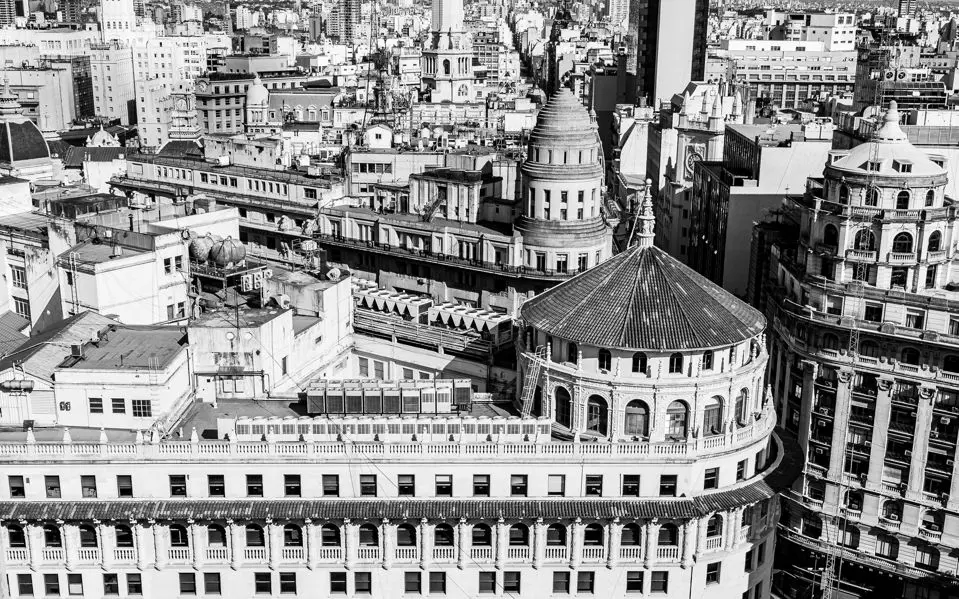
Downtown Buenos Aires is the foundational and political heart of Argentina. Unlike other neighborhoods known for their parks or modern cuisine, downtown is an open-air architectural museum . Here, French-style domes, brutalist skyscrapers, and the last vestiges of the Spanish colonial era coexist.
If you're traveling to the Argentine capital and want to know what to do in the historic center , planning is essential. The area is full of museums, government offices, and cultural spaces. Therefore, below we detail a route with distances and necessary historical information to help you discover the best buildings to visit in Buenos Aires, along with unmissable tours and excursions .
Historic buildings of Buenos Aires on Avenida de Mayo
When planning what to see in downtown Buenos Aires , Avenida de Mayo is the best starting point. This 10-block avenue connects Plaza de Mayo with Plaza del Congreso. Inaugurated in 1894 and inspired by Parisian boulevards, it boasts the highest concentration of Art Nouveau , Neoclassical, and Eclectic architecture in the city .
House of Culture (Formerly La Prensa Newspaper)
The Buenos Aires City Cultural Center is located at 575 Avenida de Mayo. The building was originally constructed in 1898 to house the headquarters of the newspaper La Prensa.
In its heyday, the newspaper's facilities functioned as a luxury social complex: in addition to the printing presses, it had a public library of 80,000 volumes, free medical clinics for citizens, and a lavish Golden Hall inspired by the Palace of Versailles, where lectures were given.
After a restoration process that rescued its French stained-glass windows and Slavonian oak floors, the building now functions as an exhibition center and headquarters of the Buenos Aires Ministry of Culture. Guided tours are available on weekends.
Rooftop of Plaza de Mayo in the Roverano Passage
Right across from the House of Culture, at Avenida de Mayo 560, is the historic Roverano Passage, inaugurated in 1882. This building is the only one in the city that has direct access to a station of the subway network (the Peru station of Line A) from its shopping arcade.
However, its biggest current attraction is on the rooftop. On the eighth floor is the Rooftop Plaza de Mayo , a repurposed space that received a special mention as "Best Intervention in the Historic District." This 360-degree panoramic viewpoint offers a bird's-eye view of Plaza de Mayo, the Río de la Plata, and the famous architectural domes of downtown Buenos Aires .
Access to the rooftop requires prior reservation and offers private experiences that combine tourism and culture, from historical mate tastings to practical classes on preparing an authentic Argentine barbecue at sunset.
A similar option a few blocks away is the rooftop of the Palacio Barolo . Designed by the Italian architect Mario Palanti and opened to the public in 1923, the building was commissioned by the textile entrepreneur Luis Barolo, who longed to create a place of tribute to Dante Alighieri's masterpiece, The Divine Comedy . Its style blends Neo-Gothic with Hindu influences. At 100 meters tall, it was the tallest building in Latin America until 1935.
Café Tortoni
Continuing along the avenue to number 825, you'll find Café Tortoni. Founded in 1858, it's the oldest operating café in the city. Its oak-paneled hall, marble tables, and French-style stained-glass windows were once a meeting place for figures like Jorge Luis Borges , Federico García Lorca, and Carlos Gardel . It's a must-visit for a café con leche and churros in the heart of Buenos Aires' historic center.
Hidden treasures and national heritage
The city center houses administrative buildings, libraries, museums, and former government offices of great historical and aesthetic value, yet unknown even to locals . Many of these spaces go unnoticed amidst the hustle and bustle of the city. They also remain outside traditional tourist routes, whether due to a lack of promotion, their unassuming appearance from the outside, or because it is assumed they are not open to the public.
However, exploring them reveals another side of the city center. Let's look at some of the most interesting ones.
National Teachers' Library
Just over a kilometer from Plaza de Mayo, in the Recoleta neighborhood, lies the National Teachers' Library . The entrance is through Pasaje Pizzurno 953 , inside the monumental Sarmiento Palace. Its interior design is so striking that it was included in the international book Classical Library Buildings of the World . Its main reading room is notable for its enormous, smooth-shafted columns, vaulted ceilings, and capacity to house more than 130,000 books .
On the second floor, overlooking the main hall, are the American Room and the Treasure Room. This restricted-access area houses the institution's oldest bibliographic collection, including the complete personal collection of the writer Leopoldo Lugones, who was the library's director.
La Estrella Pharmacy and Museum
To learn about commerce in the old city, one must return to the area south of Plaza de Mayo . On the corner of Defensa and Alsina streets (Defensa 201) stands Farmacia La Estrella. Founded in 1838, it is the oldest pharmacy in the city. At one time, it was considered the most important pharmacy in South America.
The ground-floor shop maintains its original commercial operation, with its original walnut-carved display cases, porcelain apothecary jars, and Renaissance frescoes painted on the ceiling . Upstairs in the same historic building is the City Museum (BAM) , a space dedicated to preserving everyday objects, furniture, and urban anecdotes that explain the evolution of Buenos Aires customs.
The Obelisk and the Liberty Palace
To complete the architectural tour, continue seven blocks from Plaza de Mayo to the intersection of Corrientes and 9 de Julio avenues. This point marks the modern geographic center with the presence of the Obelisk, the 67-meter monument inaugurated in 1936 to celebrate the 400th anniversary of the city's first founding.
Heading towards the river, at 151 Sarmiento Street, stands the Palacio Libertad, formerly known as the Kirchner Cultural Centre (CCK) . This imposing building in the French academic style was inaugurated in 1928 and served for decades as the headquarters of the Argentine Postal Service .
Following a monumental restoration completed in 2015, the palace was transformed into the largest cultural center in Latin America . Inside, the restored former post offices, including Eva Perón's office, coexist with avant-garde structures such as "The Blue Whale," a suspended symphony concert hall with a capacity of nearly 1,800 spectators.
Plaza de Mayo and its founding surroundings
Plaza de Mayo is the epicenter of national civic life and can be the starting or ending point of a good tour of downtown Buenos Aires. It is located between Balcarce, Hipólito Yrigoyen, Bolívar, and Rivadavia Avenues.
In the exact center of the square stands the Pyramid of May , the first national monument inaugurated in 1811 to commemorate the May Revolution of 1810. Around this pyramid, on the tiled floor, are painted the white scarves, symbol of the Mothers and Grandmothers of Plaza de Mayo who have marched there since 1977 demanding justice for those disappeared during the last military dictatorship.
The square is flanked by the most important historical sites in Buenos Aires for the political, religious and social history of the country.
The Buenos Aires City Council
At the western end of the plaza (Bolívar 65) stands the Cabildo. It was the seat of the Spanish colonial administration and the exact spot where the first national government was formed in 1810. The original building suffered multiple alterations over the centuries, losing several of its side arches to make way for the opening of Avenida de Mayo and Avenida Julio A. Roca.
Today, the restored white structure serves as the National Historical Museum of the Cabildo and the May Revolution . Admission is free, and visitors can see artifacts from the viceroyalty era, the royal standard, and one of the few surviving wooden presses from the Jesuit missions.
The Metropolitan Cathedral
Towards the north side of the plaza, at the intersection of San Martín and Avenida Rivadavia, stands the Metropolitan Cathedral. Its exterior puzzles many visitors: instead of the classic Gothic towers or bell towers, it features a Neoclassical facade supported by twelve Corinthian columns , giving it the appearance of a Greco-Roman temple.
Inside, the cathedral houses the mausoleum of General José de San Martín, permanently guarded by the Regiment of Mounted Grenadiers. Furthermore, this site gained worldwide significance as the archiepiscopal seat of Cardinal Jorge Mario Bergoglio for 15 years, before his consecration as Pope Francis . Currently, one of its side aisles houses the Pope Francis Museum, where his personal liturgical objects are displayed.
The Casa Rosada and the Bicentennial Museum
Dominating the eastern end of the plaza (Balcarce 50) is the Government House, known worldwide as the Casa Rosada (Pink House). This monumental, eclectic-style palace is the seat of the National Executive Branch . According to historical records, the color of its facade comes from a colonial technique that used bovine blood mixed with lime to fix the paint and protect the walls from the river's dampness.
Just behind the Casa Rosada, on Paseo Colón street, is the Bicentennial Museum (currently the Casa Rosada Museum) . This underground space was built on the archaeological remains of the old Taylor Customs House and the galleries of the Buenos Aires Fort. Its collection displays presidential sashes, official carriages, and the iconic mural "Ejercicio Plástico" by Mexican artist David Alfaro Siqueiros.
Published by Has Chacon on 19/06/2026