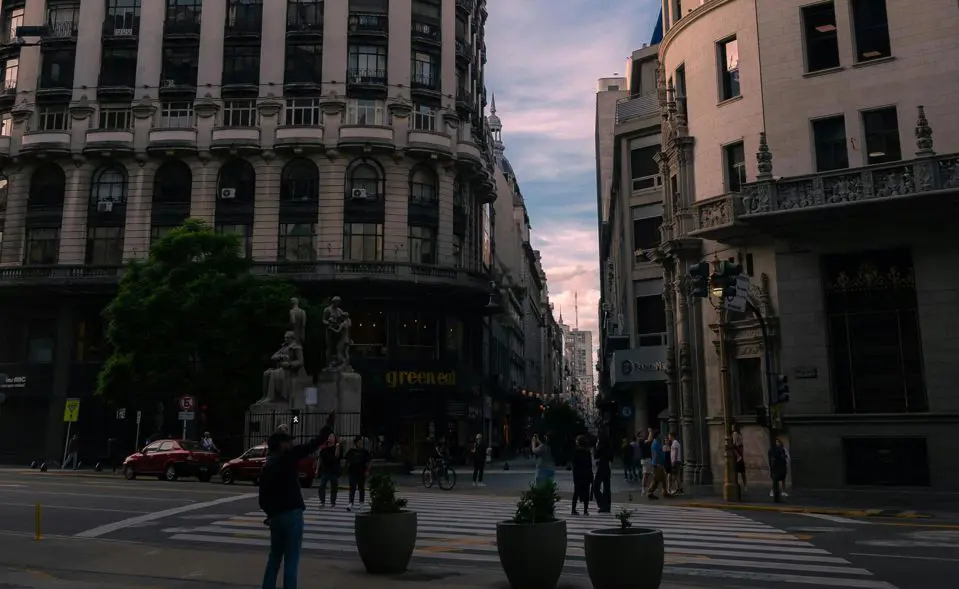
Florida Street is the heart of downtown Buenos Aires . Its pedestrian walkway stretches for almost a kilometer and is the most important and busiest commercial artery in the country. It connects Rivadavia Avenue with Plaza San Martín, passing through the San Nicolás and Retiro neighborhoods. Walking along Florida Street is the best way to experience the city's daily rhythm, admire its architecture, and take advantage of great shopping opportunities .
Next, we'll explore the most attractive sections of Florida Street and the best places to stop for a meal or a rest . You'll find information on how to get there, which corners are the most famous and why, such as Florida and Paraguay or the historic intersection of Florida and Perón . We'll discover the architectural secrets hidden in the domes and the best hotel options on Florida Street . And we'll cover the best tours in Buenos Aires to explore this and other iconic locations in the city.
If your idea is to explore Buenos Aires with everything organized, check out our travel packages with accommodation and city tours .
How to get to Florida Street in Buenos Aires and plan your route
Getting there is very simple because all forms of public transportation converge in this area . Florida Street runs through the so-called "Microcenter," a grid-patterned area that makes it easy to find your way around. Since it's exclusively a pedestrian street, there's no need to worry about traffic, making for a safe and relaxing stroll.
To make the most of your walk from the first metro station , it's best to start at the southern end and head north . Below, we'll explain precisely where to begin, which subway lines to take, and the main intersections or landmarks.
Subway line A towards Avenida de Mayo
The ideal starting point for the Florida Street walk is the intersection of Avenida de Mayo and Perú Street. If you're coming from Plaza de Mayo, where the Cabildo, the Casa Rosada, and the Metropolitan Cathedral are located, just walk one block west. There you'll find the Perú station on Line A of the subway, marked in light blue. From that corner, walk 100 meters to the right along Perú Street, cross Avenida Rivadavia, and you'll officially be at the beginning of Florida Street .
If your starting point is another part of the city, the subway is the fastest and most direct mode of transport . In addition to Line A, you can also take Line B (red) and get off at Florida station , right on the pedestrian walkway.
Another option is Line C (blue), getting off at General San Martín station , ideal for those who prefer to start their journey from the northern end and walk in the opposite direction towards Plaza de Mayo. Line D (green) ends at Catedral station, a couple of blocks from the shopping district.
Between local office workers, tourists, and shopkeepers, the street has a life of its own from early morning until nightfall . Comfortable shoes are essential, as its ten-block length can easily take two or three hours to explore if you stop to admire the shop windows and architecture.
Famous corners of Buenos Aires and the Florida promenade
About four blocks from the start is the corner of Florida and Perón streets. This intersection, formerly known as Florida and Cangallo, was home to the residences of high society in the early 19th century. Today, the area is a banking and financial hub, with imposing granite facades that reflect the economic power of Argentina's golden age .
About two hundred meters further on, the landscape opens up to reveal the intersection of Corrientes and Florida Avenues in Buenos Aires . This intersection is one of the noisiest, most vibrant, and most photographed in the city. Corrientes Avenue is famous for its theaters, traditional pizzerias, and bookstores that stay open until the early hours. Stopping at this corner allows you to observe the contrast between the constant flow of vehicles on the avenue and the leisurely pace of pedestrians on Florida Street.
Just a few meters away, on Corrientes, you'll find the iconic Güerrín pizzeria and the traditional Cadore ice cream parlor , ideal stops to recharge your energy.
Upon reaching the area of Florida and Paraguay streets , the street's character becomes more refined. Souvenir shops give way to high-end clothing stores, jewelry shops, and airline offices .
On this corner you'll also find the traditional Florida Garden , a classic Buenos Aires café that maintains its original decor and is famous for its cortado coffee and slices of ricotta cake. From here, you'll be just two blocks from the end of the pedestrian street in the leafy Plaza San Martín.
What to see and do: shopping and guided tours
Today, the aristocratic clientele of yesteryear has been replaced by a massive, dynamic, and cosmopolitan public . The range of activities is concentrated on retail, street art, and fast food .
To make the most of your time, we recommend alternating shopping trips with guided tours that provide context . Below, we'll explore the best options for buying local products, as well as professional tours that complement your experience of downtown Buenos Aires in a safe and educational way.
Premises on Florida Street in Buenos Aires
The shops on Florida Street in Buenos Aires are very diverse. You'll find stores specializing in genuine leather goods (jackets, belts, shoes, and handbags) , an undisputed classic of Argentine industry. There are also plenty of sportswear shops where you can buy the official jersey of the Argentine national team or the most popular soccer clubs.
Besides clothing and leather goods, the pedestrian street is ideal for buying artisanal alfajores, gourd mate cups with alpaca straws, and boxes of dulce de leche . The kiosks and pharmacies are open for extended hours, and the prices are very competitive, so it's worth strolling around and comparing shop windows before making a major purchase.
One detail that's immediately noticeable when walking through the area is the presence of people standing in the middle of the street shouting "Exchange! Dollars, euros, reais!" These are the well-known "arbolitos" (street money changers), who offer to exchange foreign currency for Argentine pesos on the informal market . While this practice is very common in broad daylight, we recommend exercising extreme caution. It's preferable to use the official, legal exchange bureaus located within the shopping arcades on the same block to avoid any kind of scam, counterfeit bills, or unpleasant situations.
Explore the city center with a small group city tour
If you're looking for a general overview of the city and then want to explore the pedestrian area on your own, the Small Group City Tour is the best option. This guided tour takes place in a private vehicle and is designed for comfort and exclusivity. It includes round-trip transfers from centrally located hotels.
For about four hours, an expert guide drives through the elegant neighborhoods of Retiro, Palermo and Recoleta , crossing the immense Avenida 9 de Julio (where you will see the Obelisk and the facade of the Colón Theater).
The tour also covers the southern part of the city, with must-see stops at the historic Plaza de Mayo, the picturesque San Telmo neighborhood, and the colorful Caminito pedestrian walkway in La Boca . It concludes by following the river to enter the modern Puerto Madero district. At the end of the tour, you can request that the vehicle drop you off near Florida Street to continue your afternoon exploring on foot.
Architecture and the Buenos Aires Walking Tour
Those who prefer a more active walk and want to feel the pulse of Buenos Aires' residents will find the Buenos Aires Walking Tour the perfect experience. This guided walk begins in the colonial streets of San Telmo , continues to La Boca by public bus, explores Plaza de Mayo in the heart of the historic center, and uses the subway system to culminate at the famous Recoleta Cemetery. It lasts approximately five hours and includes a quick lunch of traditional empanadas and coffee along the way.
It's the perfect plan to interact with the city's real environment, learn about the buildings, the bronze monuments, and the history of immigration . Covering the political area of the Casa Rosada and the Cabildo, it's very close to the pedestrianized Florida Street. Looking at the Art Nouveau windows becomes much more meaningful when a local guide has explained the historical context of Buenos Aires' architecture.
The iconic galleries and shopping center on Florida Street in Buenos Aires
The commercial modernization of the early 20th century brought with it the construction of covered arcades that sought to emulate the great European capitals . These spaces combined residences, theaters, and luxury shops under glass and marble roofs.
Today, if you want to go shopping on Florida Street in Buenos Aires , you have to go into these majestic buildings. Let's look at the two most important shopping complexes on the pedestrian street, which function as both modern shopping centers and art museums accessible to everyone.
The Güemes Gallery and its secret viewpoint
At 165 Florida Street, about 150 meters from the start of the route from Rivadavia Avenue, is the main entrance to the Galería Güemes . Inaugurated in 1915, it was one of the first Art Nouveau skyscrapers in the region. The building was conceived as a city under one roof: it housed a theater, a cabaret, a top-tier restaurant, offices, residential apartments, and dozens of shops.
The most impressive sight when strolling through its central corridor is the glass dome, framed by bronze lanterns and original stained-glass windows . Its cultural significance is so great that the French writer Antoine de Saint-Exupéry lived in one of its apartments, and the Argentine writer Julio Cortázar immortalized it in his celebrated short story "The Other Heaven." In 1917, Carlos Gardel sang in its basement, marking a milestone in the history of tango music.
The biggest secret of the Galería Güemes lies on its 14th floor, 87 meters high . It's a 360-degree observation deck that reopened to the public in 2013, offering panoramic views of the city, encompassing the Río de la Plata and, on clear days, the Uruguayan coast.
Access costs approximately $3 and is available Monday through Friday during morning and afternoon hours . As evening falls, the terrace houses the Rooftop Bar Florida 165 , a perfect space to relax with a signature cocktail under the illuminated domes of the Microcentro.
Shopping and art at Galerías Pacífico
About 600 meters to the north, at the intersection of Florida and Avenida Córdoba, stands the most beautiful shopping center in the capital: Galerías Pacífico . The building dates from the late 19th century and was designed based on the plans of the Le Bon Marché department store in Paris. In 1989 it was declared a National Historic Monument and, in the early 1990s, it was completely restored to function as the large shopping complex it is today.
It houses over 150 stores featuring leading national and international brands of clothing, design, jewelry, perfumes, leather goods, and technology. Its food court is located in the basement and offers a variety of dining options.
In 1946, Argentine artists Antonio Berni, Lino Enea Spilimbergo, Juan Carlos Castagnino, Demetrio Urruchúa, and Manuel Colmeiro painted frescoes on the concave vaults, transforming the shopping arcade into a veritable free art gallery . Entering the main level, standing in the exact center of the building, and looking up at the painted ceiling is a truly cinematic moment.
The story of Florida Street, Buenos Aires
The history of Florida Street in Buenos Aires runs parallel to the development of the country. That's why its paving stones bear witness to the most significant political, social, and cultural events of the last three centuries .
Long before becoming a major shopping district, Florida Street was a dirt path leading up from the banks of the Río de la Plata . Understanding the urban transformation this route underwent, from colonial times to its final pedestrianization in the 1970s, adds invaluable value to the experience. Below, we detail the historical milestones that shaped its identity.
From the colonial era to the arrival of progress
During the city's founding, this road was known as "Calle San José." Years later, residents began calling it " Calle del Correo " (Post Office Street), because the official post office operated at what is now the corner of Perú and Hipólito Yrigoyen streets. In 1808, it was named Unquera, but finally, in 1814, the Directory government renamed it Florida in commemoration of the Battle of Florida , a key military victory in Upper Peru during the wars of independence.
The area has always been a reflection of Buenos Aires' progress. It was one of the first streets to be paved, and in 1856, it inaugurated the city's gas lighting . Later, in 1895, incandescent gas lighting was installed, and in October 1900, it was illuminated with electric light, coinciding with the official visit of the President of Brazil .
Horse-drawn trams also ran through here, but were suspended at the end of the 19th century because the width of the street caused frequent accidents with pedestrians.
Population growth and the purchase of motor vehicles in the early 20th century overwhelmed the area. For this reason, in 1922, the municipal government prohibited vehicle traffic between 11:00 a.m. and 8:00 p.m. Finally, in 1971, the street was leveled with the sidewalks and permanently transformed into the pedestrian zone we know today.
Historical events on its corners
The walls and corners of this thoroughfare witnessed crucial moments. As we mentioned when passing the intersection of Florida and Perón (Cangallo), Mariquita Sánchez de Thompson resided there. The intellectual and political elite of 1813 gathered in the salons of that house, and it was precisely there that the Argentine National Anthem was sung for the first time , performed on the piano by Blas Parera.
The use of this space as a venue for public celebrations has a long tradition. After defeating Juan Manuel de Rosas at the Battle of Caseros in 1852, General Justo José de Urquiza made his triumphant entry, marching down this very street at the head of the Grand Army , acclaimed by the people from the balconies. Two decades later, in 1870, the victorious troops returning from the Paraguayan War also paraded through here.
By the late 19th and early 20th centuries, Florida Street had become the preferred promenade of the aristocracy , earning it the reputation of being the "Rue de la Paix" of South America. Former presidents such as Bartolomé Mitre and Julio Argentino Roca strolled along it daily after work, and world-renowned figures like tenor Enrico Caruso, actress Sarah Bernhardt, and writer Anatole France walked its streets during their visits to the country.
Where to stay: hotels on Florida Street, Buenos Aires
Choosing accommodation in Buenos Aires is a key decision. In that sense, Florida's central location is unbeatable for those who prefer to get around primarily on foot. Furthermore, it offers immediate access to the city's public transportation network. This allows you to enjoy a late dinner, stroll under the neon lights of Avenida Corrientes, attend a top-notch theater performance, and easily and quickly walk back to your hotel.
The area offers accommodation options for all budgets, from youth hostels to five-star hotels . Below, we review the best choices to ensure a comfortable stay and easy access to the capital's main attractions.
NH Collection Buenos Aires Florida
The NH Collection Florida is one of the most prestigious hotels in the area. It stands out for its location on the pedestrian promenade and offers modern, soundproof rooms. Its high-end amenities include a gym, meeting rooms, a breakfast buffet, and signature cuisine in sophisticated settings.
Splendor by Wyndham Buenos Aires
The Esplendor Tango in Buenos Aires is a restored historic building next to Galerías Pacífico . It combines a Neo-Renaissance facade with a cutting-edge interior design. Nearby, the Claridge Hotel (located on Tucumán Street, just steps from the pedestrian area) offers a classic English hotel experience. The latter is known for its traditional bar, which hosts popular and elegant afternoon teas.
Cheap hotels near Florida Street in Buenos Aires
The Regis Hotel and the 725 Continental Hotel offer excellent general services at prices ideal for tighter budgets. Both serve generous buffet breakfasts and feature panoramic terraces perfect for enjoying the evenings during the summer months.